
Twists around a shaft
Torsion springs
A torsion spring works by twisting around a shaft. On many residential doors, the shaft sits above the opening. Other layouts, including rear-mounted systems, need a different assessment.

Garage Door Knowledge Center
Know the signs. Understand your spring system. Choose the right next step.
Published by Trinitron Garage Doors · Meet owner Wesley Zietz
Manufacturer references and photo credits are listed in this guide.
A homeowner’s guide
Your springs counterbalance the weight of the garage door. When a spring breaks, the door can become difficult or unsafe to move. A repair needs to restore the balance of the whole system.
This guide explains what you may be seeing and what to discuss with your technician before the work begins.
Suspect a broken spring? Stop operating the door. Do not pull the emergency release, test its weight, or touch springs, cables, drums, or attached brackets. Keep clear and contact a trained door technician. Safety source [1]
Recognize the problem
Describe what you have already noticed. These clues help explain the problem, but a symptom by itself does not confirm which part failed.
A separation in an exposed spring is a reason to stop using the door and arrange an inspection. Some springs are enclosed and cannot be seen.
Tell your technician if you heard a sudden bang and the door then stopped working normally. Report the sequence without operating it again.
Report straining, uneven movement, or a door that stopped partway. A spring, cable, track, or opener issue can need further inspection.
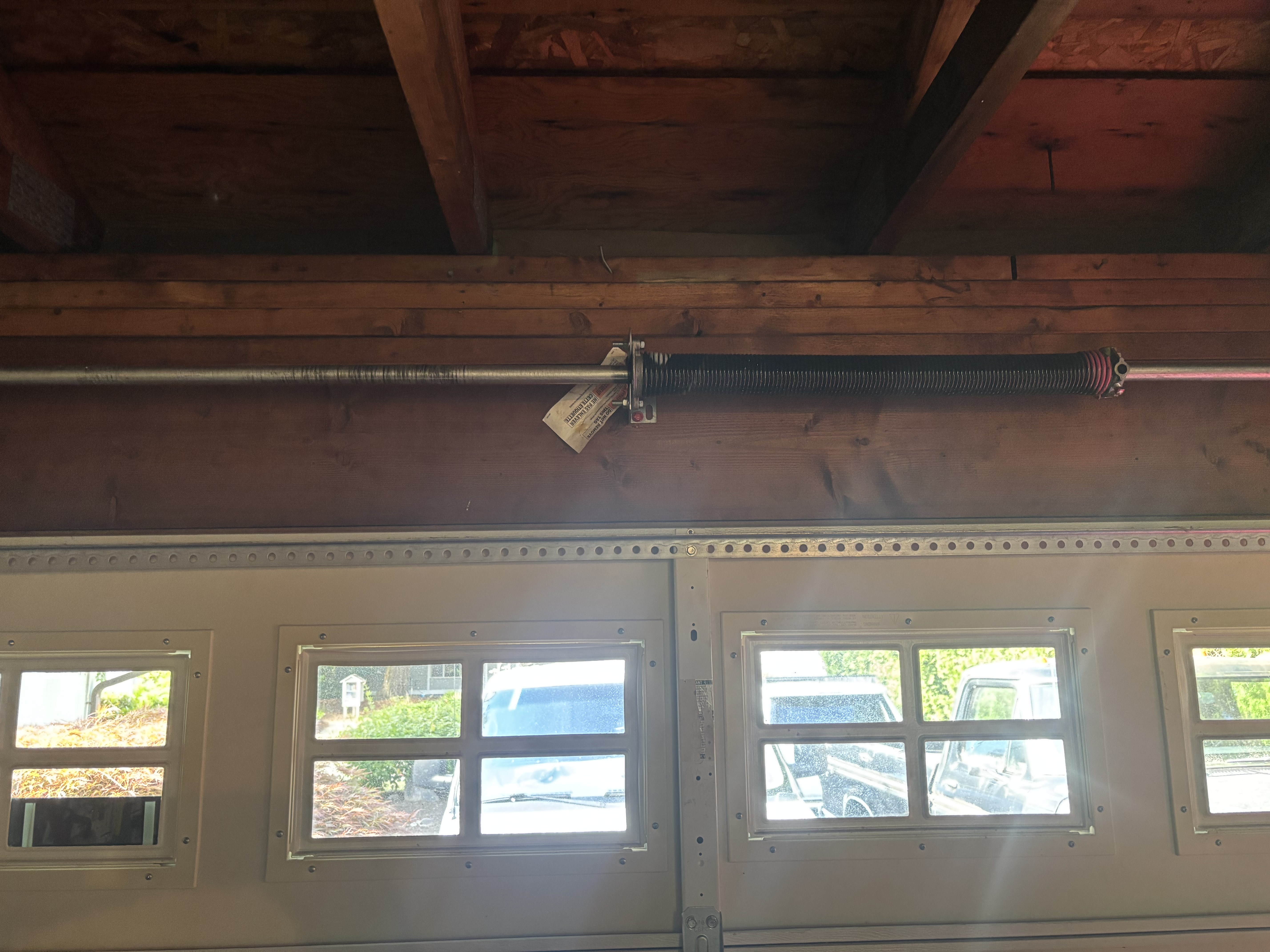
A closer look
Near the right end of this torsion spring, a gap exposes the metal shaft between the separated coils. That visible break is the detail to notice.
Already see something similar?
Leave the door in place and arrange an inspection. You do not need to get closer or take measurements.
A squeak alone does not establish a broken spring. General spring and cable guidance: DASMA safety tips [2].
Understand the hardware
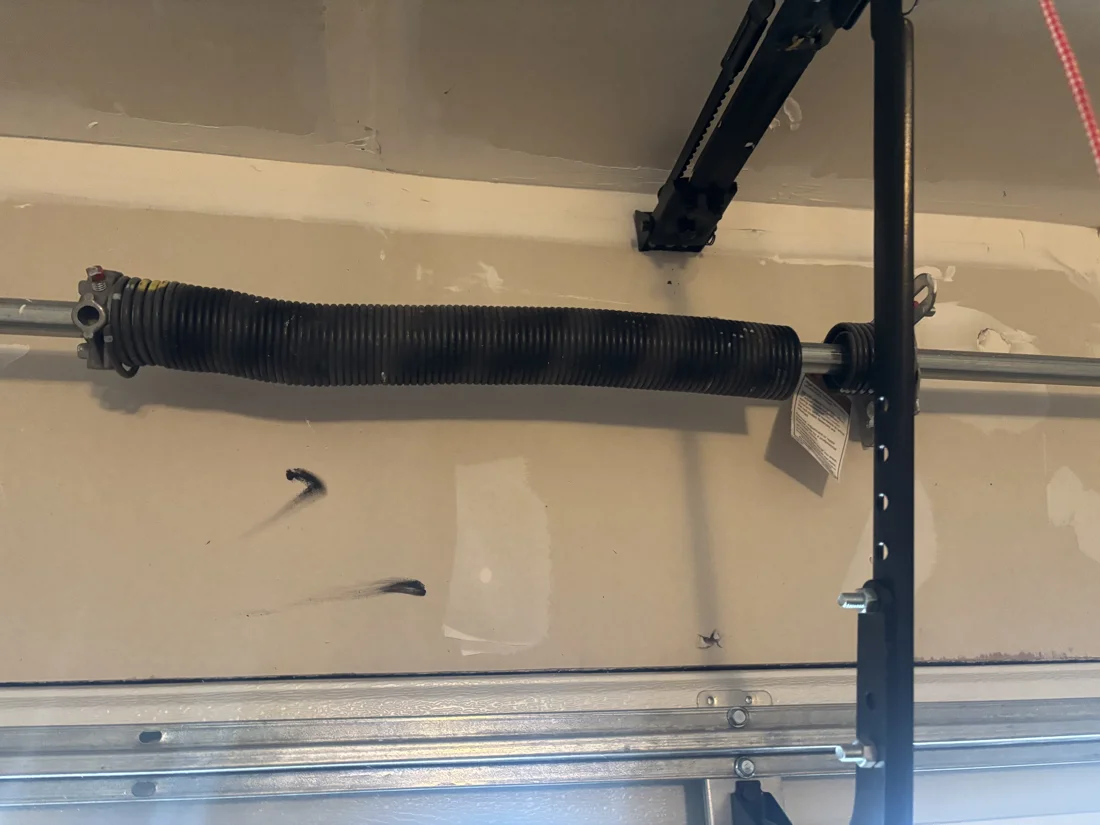
Both systems help counterbalance a door, but they store energy differently. These photographs show two common arrangements. Your installation may look different, and the extension example below has a missing containment cable.
Twists around a shaft
A torsion spring works by twisting around a shaft. On many residential doors, the shaft sits above the opening. Other layouts, including rear-mounted systems, need a different assessment.

Stretches alongside the track
An extension spring works by stretching and is commonly alongside the horizontal track. A containment cable helps restrain the spring if it breaks. Ask for an inspection if this cable is missing.
Terminology and containment references: DASMA TDS 160 [4] and TDS 167 [1]. Photos illustrate the hardware; they do not establish which replacement parts your door needs.
Why springs wear out
One cycle is a full opening and closing of the door. A household that uses the garage as its main entrance can put more cycles on its springs than a household that rarely opens it.
Cycle life also depends on correct selection and installation, corrosion, handling, and maintenance. Adding weight to the door may change its counterbalance requirements. A cycle rating is not a guarantee of a specific service life.
Technical references: spring cycle life [3] and cycle terminology [4].
Make an informed choice
The useful comparison is the complete scope of work. Ask what has failed, which components are included, and how the door will be checked after the repair.
Identify the spring arrangement and door requirements. Ask whether cables, bearings, pulleys, or other hardware also need attention.
Clarify whether the quote covers one spring, a pair, or a system conversion. Discuss required work, optional upgrades, and the written warranty.
Ask your technician how door balance, travel, and the opener’s safety functions will be checked before the job is complete.
Choose your spring repair in the Repair Wizard, review the quote, and continue to booking. Unsure what to choose? Call Wesley or request an estimate.
From our customer stories
The spring system and the surrounding hardware shape the repair. These two projects involved different systems and different scopes of work.

In her review, Aneesha reported quieter, smoother operation after the conversion and maintenance.
Laurence reported a substantial improvement in how the door ran and appreciated the explanation of the problem.
Summaries use the work descriptions and customer feedback on the linked project pages. Each job has its own scope; your repair and price may differ.
Quick answers
DASMA recommends replacing both on a two-spring door. Ask your technician about the history and condition of the pair and what the quote includes. A replacement must be selected for the door’s requirements. Source [2]
Do not operate a door with a broken spring. Leave it in place and tell your technician that a vehicle is trapped. Avoid pulling the emergency release or trying to lift the door yourself. Source [1]
A spring failure and an opener failure are different issues. Ask for the door’s counterbalance and the opener to be assessed before deciding which equipment to replace. Tell your technician whether the motor was used after the spring problem started.
It depends on the door and the installation. Ask why a conversion is proposed, whether the available space suits it, and which components and labor are included. The number or location of springs alone does not tell you which repair is appropriate.
Tell us whether the door is open or closed, what happened before the problem started, and whether access is urgent. A wide photo taken from a safe position can help explain the layout. Do not move the door, climb toward the spring, or handle parts to get a picture.
Read the source material
The technical references below come from the Door & Access Systems Manufacturers Association (DASMA). Follow the manuals for your exact door and opener; this page cannot confirm a diagnosis or safe operation.
Help from Trinitron Garage Doors
Work with a local, veteran-owned garage door business serving Puget Sound. Review your repair options online or talk them through with Wesley.